Posted by Continental Steel & Tube Company on | Leave a Comment
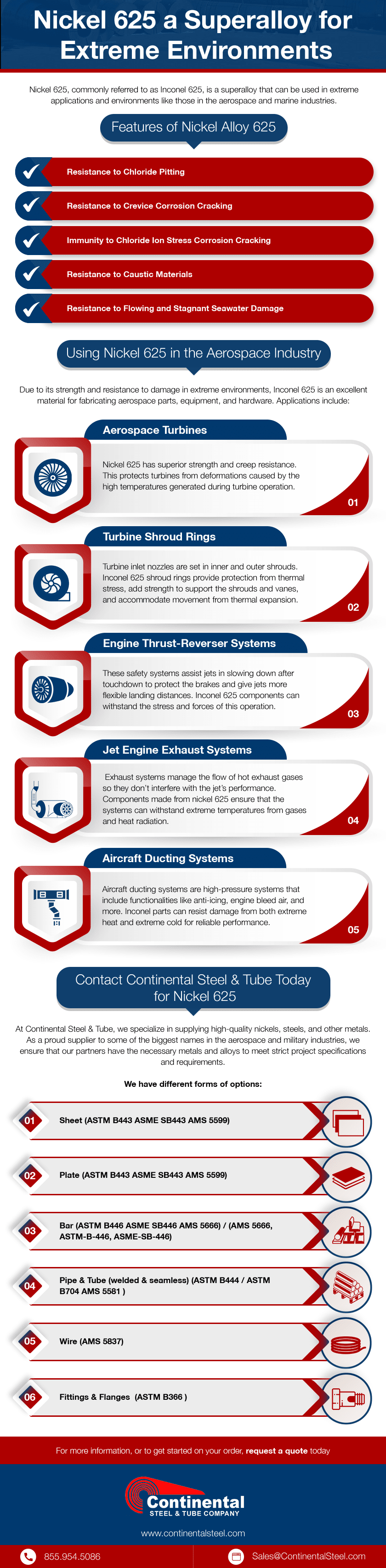
Nickel 625, commonly referred to as Inconel 625, is a superalloy that can be used in extreme applications and environments like those in the aerospace and marine industries.
This austenitic alloy has exceptional resistance to oxidation, corrosion, and fatigue, and it has excellent toughness and strength at extreme temperatures. Nickel 625 derives its strength and corrosion resistance from its molybdenum and columbium content, making it suitable for a variety of oxidizing and non-oxidizing environments.
Features of Nickel Alloy 625
Nickel 625 possesses a unique combination of features that makes it ideal for extreme environments. These features include:
Resistance to Chloride Pitting
Chloride pitting is a type of pitting corrosion that can degrade metals through small weak points. If the external surface layer of an oxidized or treated material is scratched or the underlying material is otherwise exposed, pitting can occur. Nickel 625 is resistant to this form of corrosion.
Resistance to Crevice Corrosion Cracking
Components constructed from nickel 625 are resistant to crevice corrosion. This type of corrosion is caused in stagnant fluids like seawater, which can penetrate small cracks and pits to create a high-pH environment that degrades the metal.
Immunity to Chloride Ion Stress Corrosion Cracking
When tensile stress and corrosive chloride ions combine, they can cause cracks to appear in impacted metal surfaces. Nickel 625 contains enough nickel to resist this form of corrosion, making it a superior choice to stainless steel.
Resistance to Caustic Materials
Nickel 625’s high nickel content protects it from damage in alkaline solutions and exposure to hydrogen ions.
Resistance to Flowing and Stagnant Seawater Damage
Because of its unique resistance to pitting and other forms of corrosion, nickel 625 can withstand seawater moving at different speeds without the risk of wearing away or degrading the surface of the metal.
Using Nickel 625 in the Aerospace Industry
Due to its strength and resistance to damage in extreme environments, Inconel 625 is an excellent material for fabricating aerospace parts, equipment, and hardware. Applications include:
● Aerospace Turbines. Nickel 625 has superior strength and creep resistance. This protects turbines from deformations caused by the high temperatures generated during turbine operation.
● Turbine Shroud Rings. Turbine inlet nozzles are set in inner and outer shrouds. Inconel 625 shroud rings provide protection from thermal stress, add strength to support the shrouds and vanes, and accommodate movement from thermal expansion.
● Engine Thrust-Reverser Systems. These safety systems assist jets in slowing down after touchdown to protect the brakes and give jets more flexible landing distances. Inconel 625 components can withstand the stress and forces of this operation.
● Jet Engine Exhaust Systems. Exhaust systems manage the flow of hot exhaust gases so they don’t interfere with the jet’s performance. Components made from nickel 625 ensure that the systems can withstand extreme temperatures from gases and heat radiation.
● Aircraft Ducting Systems. Aircraft ducting systems are high-pressure systems that include functionalities like anti-icing, engine bleed air, and more. Inconel parts can resist damage from both extreme heat and extreme cold for reliable performance.
Contact Continental Steel & Tube Today for Nickel 625
At Continental Steel & Tube, we specialize in supplying high-quality nickels, steels, and other metals. As a proud supplier to some of the biggest names in the aerospace and military industries, we ensure that our partners have the necessary metals and alloys to meet strict project specifications and requirements.
Posted by Continental Steel & Tube Company on | Leave a Comment
Nickel alloys are composed of nickel and copper, as well as smaller amounts of iron, manganese, carbon and silicon. The combined properties of these elements make nickel alloy both easier to machine and stronger than the elements would be on their own.
Nickel—or at least commercially pure nickel—is a metal with a high electrical conductivity, exceptional magnetostrictive properties, and a high Curie temperature. Its excellent thermal conductivity makes it ideal for use as heat exchangers in corrosive environments. Its corrosion resistance, especially with caustic alkalis, makes it useful for maintaining product quality in various chemical reactions, and essential in food processing and synthetic fiber manufacturing.
Aluminum (also known as aluminium) is a metal that is both soft and light, and is used to produce a large number of metal products in the aerospace industry, as well as packaging, such as aluminum cans. Telescope mirrors are also coated with a thin layer of aluminum. Ideal in metal production due to its light weight and durability, aluminum easily forms alloys with various other elements in nickel alloys. The use of aluminum in a nickel alloy will decrease the weight and make an alloy easier to machine.
Copper is a common element found in the environment, and is a reddish metal that is easy to polish to a shine. Copper is often used for electrical equipment due to its conductive properties for both heat and electricity. Besides its conductive properties, copper is anti-magnetic and is resistant to corrosion. It will form a greenish film, known as patina, which protects it from further corrosion, is easy to alloy and provides an anti-bacterial element. Used in alloys, it will increase the electrical and heat conduction of the material and help to make it resistant to corrosion.
Carbon provides a number of applications, from decorative (such as diamonds) to printer ink and pencil tips. Carbon provides greater strength and increases hardness in a material. The drawback of carbon is that it makes material much harder to machine, so must be present in an amount that allows material to be worked as needed, yet still be strengthened.
Manganese is pink-grey in color and is also essential to iron and steel production. It is used in stainless steel formulas and aluminum alloys that are in wide use. This element, however, like carbon, is strong but brittle, so it cannot be used by itself in alloys. Manganese used in a nickel alloy will add strength to the alloy.
Silicon is used in nickel alloys to provide resistance to the electrical conductivity of copper and other metals. It is the most common element found naturally in the earth’s crust, and is very brittle with a metallic appearance.
All of the above elements can be included in various nickel alloys to change the properties of the alloy itself. Conductivity, strength, weight and resistance to the environment are all affected. The combination of all elements is determined by the intended use of the alloy being produced and, combined, increase the ability of the alloy to be used for various purposes.
Posted by Continental Steel & Tube Company on | Leave a Comment
It is critical for piping systems in subsea applications to maintain their reliability and integrity. When selecting the material for these systems, you need to optimize investment and operational costs, in a way that Life Cycle Costs (LCC) are minimized while providing acceptable safety and reliability.
When piping is used for critical applications such as firefighting, cooling of process equipment, and water injection to the oil well, maintaining integrity of the pipe for long-term performance is high on the list of priorities.
Challenges of Subsea Petrochemical Applications
In subsea applications, especially, these pipes need to provide reliable and high quality performance while water is injected to recover as much oil as possible. In these environments, saltwater will work to corrode common metals like carbon and stainless steel. The best way to protect these pipes is to use Monel®, Inconel®, or any similar nickel alloy.
The demand for nickel alloys in the oil and gas industry has increased lately, driven mainly due to corrosion resistance. Other factors that make nickel alloy attractive option are the temperature and pressure in which these pipes will operate.
General Considerations for Developing a Subsea Piping System
When designing a piping system, it is imperative to keep a few points in mind.
Cost efficiency – The materials you choose need to not only perform well, but also be cost effective.
Product life – The pipe will need to last, but also needs to provide dependable service over extended periods.
Operating conditions – Subsea operations expose pipes to corrosion and abrasions. It is imperative to choose materials like Inconel® and Monel® that are proven to withstand corrosive environments.
Weight reduction
Inspection and corrosion monitoring possibilities – You need to make sure that whatever materials you chose can be verified to be working properly after installation.
Special attention to any adverse effects the material selection could have on human health, the surrounding environment, and safety.
Subsea Applications with Continental Steel & Tube
As an industry-leading supplier of a wide variety of nickel alloys for marine applications, Continental Steel & Tube can provide you with solutions necessary for subsea processes. Our inventory includes a range of Inconel®, Monel®, and copper nickel, allowing us to help you design solutions for every consideration. Contact us today to learn how we can help you with all your subsea application needs.
Posted by Continental Steel & Tube Company on | Leave a Comment
Learn when to use nickel and how to meet its challenges.
Although Continental Steel & Tube does not machine nickel alloys, we wanted to provide a useful article to our current and future customers who do.
Nickel as a material has a long history in countless applications, from its use as a plating, to an element in super alloys, it provides characteristics that have benefitted many industries. When used as a primary alloy material in high specification steels, nickel transforms its role from aesthetic to that of a strength-giving component that also brings in corrosion resistance.
This ideal combination has turned nickel into a metallurgical component with great impact in aerospace, power generation, turbine, and other high-value applications.
Deforming challenges
Using high nickel alloys as a manufacturing material requires that process managers, machinists, and designers understand the issues nickel brings to the fabrication space. As it does not weaken or deform easier at higher temperatures, as observed with other types of alloys, nickel is more difficult to deform by high precision machining processes.
This single factor has kept some users away from nickel alloys, forcing their particular applications to suffer onward with inferior materials. In reality, it is possible for the majority of manufacturing environments to adapt to nickel machining with ease.
A Common Misconception
The reason that nickel alloys are difficult to machine, whether by cost or failure rate, is rooted in a flawed approach and inappropriate tooling: machinists, managers, and process planners treat it like high strength, heat treated alloys.
While similar in physical properties, these materials are a different animal at the literal cutting edge. Heat treated materials, especially austenitic ones, have a higher tendency to chip and break away under shear forces, like those used by the cutting tools in machining processes.
This quality is further amplified by the heat buildup that occurs in machining. Therefore, a single set of middling quality tools can be used to work on some otherwise high strength materials.
Uniform Strength Qualities
Nickel alloys express their strength qualities more uniformly – shear, tension, and compression forces are all well resisted by high nickel alloys. There is no “weak point” that can be taken advantage of for the cutting process.
Simply put, nickel alloys will require higher quality tools, featuring stronger build materials and sharper cutting abilities. Machining systems will have to be run at slower linear speeds (feed rate), and at reduced tool RPM.
Some systems will simply not be rigid enough to handle high nickel alloys. Cutting depths should be kept to a minimum, which may require part design revisions. Above all, longer cycle times will need to be specified. Rushing nickel alloys will only result in wasted material and ruined tools.
If approached smartly, nickel alloys can transform the strength profile of your parts manufacturing without incurring excessive costs. The key is in the preparation – budget time and tools for your nickel alloy process steps and the stereotypes surrounding this traditionally frustrating material will disappear.
Posted by Continental Steel & Tube Company on | Leave a Comment
Nickel is one of the most versatile elements used in industry. While nickel has been used in its pure form since ancient times, today it is most commonly employed in alloys.
Nickel’s slow oxidation rate makes it highly resistant to corrosion, and it provides excellent heat resistance as well. It has a wide solubility range with many different alloy materials, including titanium, aluminum, and iron, among others.
The corrosion resistance and high temperature strength of nickel alloys make them extensively used in the most challenging environments. They are best known for their use in chemical and aerospace applications.
Nickel alloys are heavily used for containers, pipes, and equipment associated with chemical processing, as well as a wide breadth of aerospace engineering applications. However, these alloys go far beyond just these two areas.
They are also instrumental in a number of lesser-known applications, including restaurant cooking appliances, pollution control equipment, and waste incinerators.
1. Professional Cookware
The properties that make nickel alloys the premium choice for harsh environments also make them instrumental in commercial food equipment.
These alloys help manufacturers of cooking supplies meet ANSI/NSF international standards for food equipment. Their corrosion-resistant properties allow cookware to maintain its original surface characteristics in all cooking environments, as well as after exposure to different cleaning and sanitizing compounds.
Nickel alloys also help professional cookware remain smooth and easily cleanable, ensuring that all food and soiling material can be removed with manual cleaning methods.
Nickel alloys are also heavily used in equipment that helps control emissions. Coal fired power plants play an important part in generating electric power in the USA, but the combustion of coal generates a number of pollutants that must be accounted for.
Nickel alloys are used in many capacities to help with pollution control, including the construction of absorber towers. These alloys are used to help absorb hot and concentrated amounts of sulfuric acid, among other uses. The employment of nickel alloys helps companies meet the strictest air control laws, as well as all applicable rules of the EPA.
Typical alloys for these applications include Inconel alloy 625 and 622, alloy 825 (UNS N08825), and C276 nickel alloy plate. It offers reliable performance and lowers maintenance costs for corrosive-resistant pollution control components.
3. Waste Treatment
The toughness and resilience of nickel alloys also make them widely used for waste treatment, specifically incineration.
Nickel alloys can work in the most difficult conditions. Incineration oxidizes materials such as fluorocarbons, sulfur, chlorinated organics, and brominated compounds. Corrosive chemicals and gasses are produced as the result of this process, including nitrogen oxides, hydrogen halides, and acidic gasses.
Alloys such as C276 can withstand these harsh conditions, allowing incineration to occur while protecting equipment against serious corrosion, oxidation, acidic condensate, and cycling temperatures.
Nickel alloys play a vital role in applications that need to work reliably under the most stressful conditions. They help keep food safe, promote environmental sustainability, and treat dangerous waste, performing in areas far beyond chemical and aerospace. When customers require versatile protection against extreme elements, nickel alloys can fulfill the role no matter how difficult or challenging the conditions.
For more information about nickel alloys, download our composition chart that breaks down alloys by their chemical compounds — helping you choose the proper material for your next project.
Posted by Continental Steel & Tube Company on | Leave a Comment
Maintenance, repair, and operations (MRO) teams can especially attest that MRO processes are being increasingly upgraded and updated with new, specialized materials. As new construction methods take hold, new challenges are being introduced to mechanical, plumbing, or electrical device maintenance and replacement.
Superalloys are popular in MRO processes due to their mechanical strength, resistance to creep, surface stability, and corrosion and oxidation resistance. These qualities lead to improved performance and longer life with less maintenance and easier repair.
High performance nickel alloys are used in a diverse range of industries and processes. These include aircraft, automotive, chemical processing, electrical resistance heating, electronics, telecommunications, marine, and oil and gas extraction.
What makes nickel superalloys so attractive is their resistance to corrosion and oxidation. Varieties of high performance nickel alloys include Incoloy®, Hastelloy®, Inconel® and Monel®. Each of these alloys has certain properties which make them suited for MRO applications. In particular, each alloy has certain machining and welding properties that make them more efficient and resistant to corrosion and wear.
Incoloy®
Incoloy is a line of superalloys produced by the Special Metals Corporation, a group of companies that specialize in inventing, producing, and distributing high-performance nickel alloys for specialized engineering projects, which includes inconel and monel.
Incoloy is an age-hardenable nickel-iron-chromium alloy with trace amounts of molybdenum, copper, titanium, and aluminum. There are currently 22 grades of incoloy, and they are broadly used for range of applications including oil and gas well piping, chemical processing, heat exchangers, nuclear facilities, and caruburizing equipment.
Incoloy is best suited for corrosion resistance in wet environments like plumbing systems or pipelines. It can also maintain its austenitic structure through extended periods of exposure in high temperatures.
Incoloy is best worked in temperatures of 1600°F (850°C) to 2150°F (1175°C). For best results, it is recommended to rough machine the material before age hardening and finishing after heat treatment. Incoloy’s maximum corrosion resistance and strength is achieved after aging and hot-working the alloy in the 1600°F (870°C) to 1800°F (980°C). Cold-working certain grades of incoloy make it behave similarly to other grades, such as incoloy 925, which behaves like 825 when cold-formed except with a higher work-hardening rate.
The best methods for welding incoloy are either using gas-metal-arc welding (GMAW) or gas-tungsten-arc welding (GTAW). For the former method, it is not recommended to go above 180 amps of current in the “spray arc” metal transfer mode.
Hastelloy®
Hastelloy is a high-performance nickel alloy registered by Haynes International, Inc. The primary alloying ingredient in hastelloy is typically transition metal nickel, with various percentages of copper, iron, aluminum, and titanium. Common Grades of Hastelloy include C276 and C22. Hastelloy is especially resistant to high-temperature and high-stress envionrments, and is a great alternative to iron-based alloys in terms of corrosion resistance.
The welding characteristics of hastelloy are similar to austenitic stainless steel, and hence not very difficult to weld with proper care. The preferred method for welding hastelloy is GTAW, GMAW, and shielded metal arc welding (SMAW). Other less common welding methods are plasma arc welding, resistance spot welding, laser beam welding, electron beam welding and submerged arc welding.
One of the most important issues to keep in mind when welding hastelloy is cleanliness. Contamination from greases, oils, lead sulfur, and other elements with melting points lower than nickel can cause severe problems.
Inconel®
The primary alloying ingredient in inconel is nickel-chromium. It is resistant to oxidation and corrosion, especially to chloride-ion stress-corrosion cracking. This makes it well-suited for high heat and high pressure environments. There are currently 25 grades of inconel which are commonly used in chemical and food processing, furnace components, and aerospace and land-based gas turbine parts like jet engines.
When inconel is heated, it has a tendency to form a thick and stable passivating oxide layer that protects any surface from damage. Since inconel tends to quickly work harden, welders need to minimize the number pf passes with an aggressive but slow cut with a hard tool, especially when working with age-hardened grades like inconel 718. Other Commin Inconel alloys are Inconel 600, 601, 625, 825, and x-750.
Inconel also tends to crack and segregate at a microstructural level in the heat-affected zone, which adds to the difficulty of welding it. The recommended ways of overcoming this tendency is through GTAW and electron beam welding.
Monel®
Monel—as we’ve previously talked about—is particularly resistant to high-temperature. It is composed primarily of nickel and copper, with iron, carbon, manganese, and silicon included in various percentages. Monel is highly resistant to corrosion and stronger than pure nickel. Its resistance to hydrofluoric acid, sea water, alkalies, and sulfuric acid makes it ideal for marine and chemical environments.
Monel is relatively easier to machine and weld than inconel, incoloy, and hastelloy. It is generally recommended to use a cold-drawn, stress-relieved filler material to achieve the best machinability and smoothest finish. Monel can also be welded through a wide range of common methods, including GTAW, GMAW, and SMAW.
Posted by Continental Steel & Tube Company on | Leave a Comment
The rapid pace of advancement in technology has introduced new approaches to traditional applications. As new systems are developed, and existing systems are upgraded, a variety of nickel based alloys are being used to bring about enhanced performance. For the MRO faced with working with these materials, it is important to first have a good understanding their characteristics and composition.
The popularity of superalloys is due to their superior mechanical strength, resistance to creep, surface stability, and resistance to corrosion and oxidation. This allows for improved performance and longer life with less maintenance and easier repair. They are used in a diverse range of industries and processes, including aerospace, automotive, chemical processing, telecommunications, marine, and oil and gas extraction and processing.
To get a better understanding of these dynamic materials, including the various methods of welding and machining, let’s take a close look at each one.
Incoloy®
Incoloy®—like inconel and monel—is a line of superalloys produced by the Special Metals Corporation, a group of companies specializing in the invention, production, and distribution of high-performance nickel alloys for specialized engineering projects. Incoloy is an age-hardenable nickel-iron-chromium alloy with additional amounts of copper, aluminum, molybdenum, and titanium. It is designed for superior corrosion resistance and strength at high temperatures.
Incoloy is especially resistant to corrosion in aqueous environments like plumbing systems, pipelines, or marine appliactions. It is capable of maintaining a stable and austenitic structure through protracted periods of exposure to high temperatures. Incoloy alloys—there are currently 22 grades—are typically used for a range of applications including chemical processing, oil and gas well piping, heat exchangers, carburizing equipment, and nuclear facilities.
Incoloy’s general working range of temperatures is 1600°F (850°C) to 2150°F (1175°C). To achieve maximum corrosion resistance and strength after aging, the alloy should be hot-worked in the 1600°F (870°C) to 1800°F (980°C). When cold-formed, incoloy alloy 925 behaves similarly to incoloy 825, except with a higher work-hardening rate.
The recommended materials for welding incoloy 925 is Inco-Weld® filler metal 725NDUR®, which provides stronger material with better corrosion resistance than incoloy 925. For best results, the preferred methods for welding are gus-tungsten-arc welding (GTAW) and gas-metal-arc welding (GMAW). With the latter method, current levels should not go above 180 amps for standard GMAW power sources in the “spray arc” metal transfer mode.
Hastelloy®
Hastelloy® is a proprietary superalloy from Haynes International, Inc. Hastelloy’s primary alloying ingredient is usually transition metal nickel. This is typically added to other metals like iron, copper, titanium, and aluminum to various percentages. Common Hastelloy Grades include C276 and C22.
The greatest advantage of hastelloy is its resistance to high-temperature and high-stress environments, specifically the formation of grain boundary precipitates that result from exposure to high heat. It is known for its potential to survive in severely corrosive or erosion prone scenarios where other, more common iron-based alloys would quickly fail.
Hastelloy is particularly resistant to wet chloride gas, chlorine, and oxidizing salts such as ferric and cupric chlorides. It is typically used in nuclear and chemical reactors, distillation equipment, and pipes and valves in the chemical processing.
There are two types of recommended filler materials for hastelloy: matching and overalloyed. Matching filler material means that the filler material is made of the same chemical composition. Overalloyed filler materials mean non-matching, highly-alloyed, highly corrosion-resistant welding filler material, which reduces the chance of preferential weld metal corrosion attack.
The preferred methods of welding hastelloy are GTAW, GMAW, and shielded metal arc welding (SMAW). Due to the sluggish welding and shallow penetration characteristics of nickel-based alloys, it is important to pay careful attention to joint design and weld bead placement to ensure solid welds with proper weld bead tie-in. It is also recommended to grind starts and stops, since these alloys have a tendency to crater crack.
Inconel®
Inconel® is a superalloy where the primary alloying ingredient is nickel-chromium. It is oxidation and corrosion resistant, especially to chloride-ion stress –corrosion cracking, which makes it well-suited for high pressure and heat environments. This is because when inconel is heated, it forms a thick, stable, passivating oxide layer that protects the surface from additional damage. It’s suited to a wide range of temperatures, which makes it a great alternative to other metals like aluminum or steel which are susceptible to creep.
Inconel currently has 25 grades. Inconel 600, 601, 625, 825, x-750 are some of the more commonly used incoloy alloys. They are typically used for furnace components, chemical and food processing, aerospace and land base gas turbine parts like jet engines, and other extreme-service applications.
Inconel has a tendency to quickly work harden, so it is necessary to machine age-hardened grades like 718 with an aggressive but slow cut with a hard tool to minimize the number of passes. Welding inconel is also difficult since it tends to crack and microstructurally segregate in the heat-affected zone. The most common ways to overcome this is through GTAW and electron beam welding.
Monel®
We’ve previously talked about Monel®, focusing particularly on its high-temperature properties. This superalloy is primarily composed of nickel and copper, with trace amounts of iron, manganese, carbon, and silicon. Monel has excellent corrosion resistance and is stronger than pure nickel. Although it is more difficult to fabricate than steel, its high sulfur content gives it better and enhanced machinability.
Monel is ideal for marine and chemical environments due to its resistance to sea water, hydrofluoric acid, sulfuric acid, and alkalies. It has ASME approval for use in boilers, pressure vessels and nuclear vessels. It is typically used in heat exchangers, oil refinery piping, sulfuric acid plants, nuclear fuel production, and pump shafts.
Unlike inconel, incoloy and hastelloy, monel is relatively easier to machine and weld. In general, it is recommended to use cold-drawn, stress-relieved material for the best machinability and smoothest finish. Similarly, monel can be welded through a wide range of conventional welding methods, including SMAW (best for monel 400), GTAW, and GMAW (best for Monel Filler Metal 60).
Posted by Continental Steel & Tube Company on | Leave a Comment
When a company lists an alloy as “high-temperature” what exactly does that mean? This may not seem that important but it is in fact a critical question to be considered and to answer. Misjudging temperature thresholds can spell disaster, for both safety and your bottom line. In this article we will look at the popular high-temperature alloy, Monel, and try to answer the question “How hot can Monel get?”
Monel, which comes in five different forms (plate, sheet, tube, pipe, pipe fittings, round bar, and wire), is a nickel alloy that contains roughly 70% nickel, 29% copper, and a small mix of iron, manganese, silicon, and carbon. The most common grades of Monel are Monel 400, Monel 405, and Monel K500, each with their own unique properties. Commercial and industrial clients choose Monel for its variety of outstanding features including:
Strength (stronger than steel)
Excellent corrosion resistance including alkalis, salt water, and sulfuric and hydrofluoric acids
Workability/Malleability
Ease of welding, brazing, and soldering
Low coefficient of thermal expansion
Ability to hold up in high temperature situations as well as low temperatures
As you might expect, these properties attract many manufacturers for a variety of applications. Monel can be found in applications such as:
Brine heaters, seawater scrubbers
Heat Exchangers
Oil refinery piping
Feed water and steam generator tubing
Electronic components
Propeller shafts
Building materials including ductwork, flashing, chutes, and downspouts
As you can observe from this brief list, maintaining certain temperature levels plays a major role in their operation. If you create a heat exchanger with an improper alloy, the exchanger becomes an accident that is waiting to happen.
So how hot can Monel get? Properly treated Monel will hold good mechanical properties from subzero temperatures, all the way up to 480°C (896°F). It has an impressive melting point of 1300-1350°C (2372-2462°F), and a Curie temperature of 35°C (95°F).
While Monel does rack up some impressive numbers, there are alloys that do even better in high temperatures. For instance, Incoloy has a maximum operating temperature of 871°C (1600°F) while Inconel’s is 982°C (1800°F) and Nichrome V tops out at 1093°C (2000°F).
Monel is just one of the outstanding options for those in search of a high-temperature alloy. What really matters in the end is your ability to match up the best and most precise alloy with the unique needs of your application. Monel might offer outstanding strength, but if you need your alloy to function over 896°F then Inconel might be right for you. This is when a highly trained alloy expert really comes in handy.
We use cookies to ensure that we give you the best experience on our website. If you continue to use this site we will assume that you are happy with it.


 The corrosion resistance and
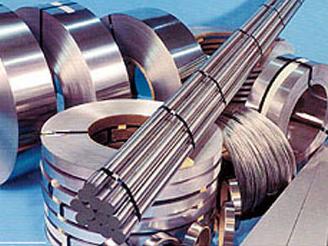
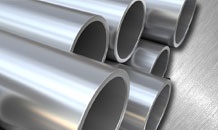 The popularity of superalloys is due to their superior mechanical strength, resistance to creep, surface stability, and resistance to corrosion and oxidation. This allows for improved performance and longer life with less maintenance and easier repair. They are used in a diverse range of industries and processes, including aerospace, automotive, chemical processing, telecommunications, marine, and oil and gas extraction and processing.